




How Many Axes Does a CNC Milling Machine Have? 3, 4 and 5 Axis Explained
Axis count is the first specification buyers ask about, yet it is also the one most often reported without context. A cnc milling machine may be sold as three axis, four axis or five axis, and the difference changes both the parts it can reach and the programming effort it demands. This guide explains what each axis adds, where the useful boundary lies, and which published machine figures actually matter.
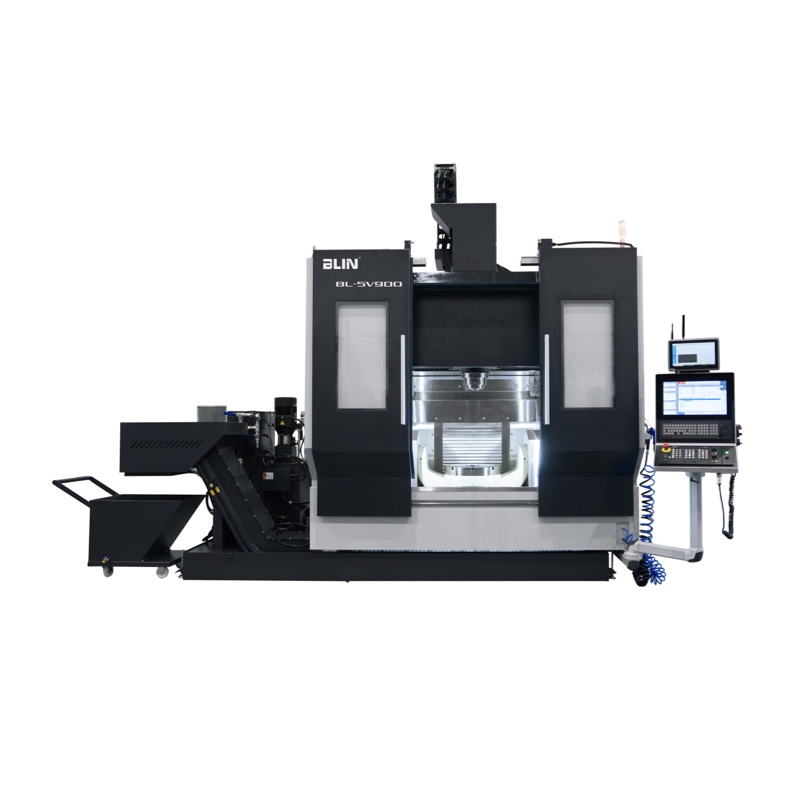
Key Takeaways
A standard vertical mill has three controlled linear axes: X, Y and Z.
A fourth axis is rotary, indexed or continuously driven, and a fifth adds a second rotary motion.
Five axis capability is not one feature: indexed 3 plus 2 work and simultaneous five axis interpolation are different jobs.
Axis count does not override travel, table load, spindle power, guidance or thermal stability when matching a machine to a part.
How Many Axes Does a CNC Milling Machine Actually Have?
The short answer is three. A conventional vertical machining center moves the tool relative to the workpiece along three straight lines, and nearly all prismatic parts can be produced with those three motions. A fourth or fifth axis is an addition, not an upgrade that makes every job better. Before comparing specifications, it helps to be clear about what a CNC milling machine is and how its control turns a program into movement.
What the Three Linear Axes Do
The X axis carries motion left to right across the table, the Y axis carries motion front to back, and the Z axis raises and lowers the spindle. Together they describe a rectangular work envelope. The controller commands position along each line, while the spindle supplies rotation at the cutter. A machine with three axes can still cut curved surfaces by stepping the tool along many small straight segments, but any face that is not presented to the spindle requires the part to be reclamped.
Three Axis CNC Milling Machine: The Standard Configuration
A three axis vertical center is the default for brackets, plates, housings, pump bodies and tooling plates. Simpler programming, shorter prove out and easier inspection are practical advantages: the tool approaches from one direction, so collisions are easier to predict. Published examples from one machine family show how the same axis count serves different duties through structure rather than extra motion. A heavy model uses box guideways on all three axes and an optional BT50 spindle with 15 kW or 18.5 kW motors for steel roughing, while a general purpose model uses roller guideways on all three axes with pre stretched C3 ball screws and tables from 1000 mm to 2000 mm.
Where a part is long rather than complex, the limiting figure is travel rather than axis count. A machine built for aerospace beams and large plates publishes a 2050 mm X stroke and a Y axis carried on four rails with eight blocks. That geometry reaches parts a compact five axis center cannot hold, even though it has fewer controlled axes.
Three models from the same published range show how three axis and five axis platforms divide the work.

BL-V11
General purpose vertical center with roller guideways on three axes, bridge column and a 24T arm type tool changer.
View Product
BL-V4
Compact bridge column machine for small and medium parts, with tool change as fast as 1.8 seconds and rapid traverse up to 36 m/min.
View Product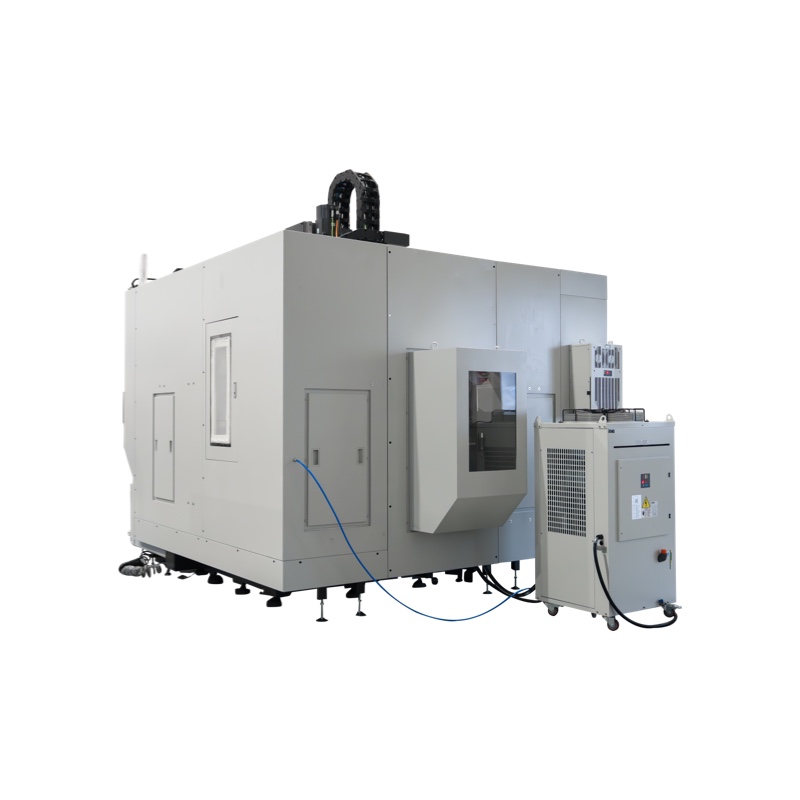
BL-5V500
Compact five axis center with an overhead gantry rotary axis, direct drive A and C table and an 18,000 rpm HSK-A63 spindle.
View ProductCompare Axis Configurations Against the Real Workpiece
Published travel, table load, spindle data and axis arrangement can be reviewed together before a specification is fixed.
Four Axis CNC Milling Machine: Adding One Rotary Axis
The fourth axis rotates the workpiece or the tool holder around one of the linear axes. It is labelled A, B or C depending on the direction of rotation. A rotary table can index to a fixed angle so a second face can be milled without manual reclamping, or it can rotate continuously while the cutter feeds along a path. The first case is an indexing application; the second is used for features that wrap around a cylinder, such as slots, flats and helical grooves.
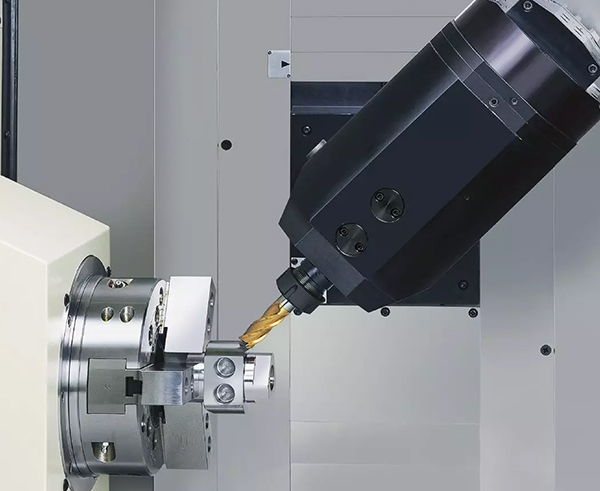
One rotary axis adds reach, but it does not remove every setup. A part still has to be presented to the tool for faces outside the rotary range, and the fixture has to clear the table as it turns. A four axis arrangement is often the economical answer when the extra face is simple and the production batch does not justify a more complex machine.
Five Axis CNC Milling Machine: Two Rotary Axes
A fifth axis adds a second rotary motion, usually a tilt of the table or of the spindle head. With three linear and two rotary axes, the tool can approach a surface from almost any direction. This is valuable on impellers, turbine components, mould cavities and curved housings, where a short stiff cutter can follow the surface instead of a long tool reaching down into a deep cavity.
A five axis cnc milling machine is not automatically running all axes at once. In indexed 3 plus 2 work, the rotary axes move to a fixed orientation, lock, and the three linear axes do the cutting. In simultaneous work, all five axes interpolate along one path. Simultaneous motion permits smooth freeform surfaces but demands tool path verification, collision checking and a control that supports five axis transformation and tool compensation. The published BL-5V series describes an overhead gantry AC axis, dual torque motor direct drive, dynamic five axis transformation and three dimensional tool compensation, and larger gantry versions carry the same arrangement into a bigger envelope.
Axis Count Is Not the Only Machine Limit
Axis count describes the number of controlled directions. It says nothing about the distance available in each direction, the mass the table can carry, the force the spindle can deliver, or how much the structure moves as it heats. A five axis machine with a small envelope cannot hold a long beam; a three axis machine with box ways may remove stock faster in hardened steel. Independent work on standardized five axis performance tests shows why simultaneous motion has to be measured separately from individual axis errors. Guidance families also differ: box ways damp vibration under heavy roughing, ball guideways favour speed and low friction, and roller guideways spread load along a longer contact line.
Accuracy claims need the same scrutiny. A positioning figure quoted without a test method, a machine condition and an edition of the relevant test standard is difficult to compare. Ask what was measured, where it was measured and under which thermal condition before treating two numbers as comparable.
How to Decide How Many Axes Are Needed
Four questions usually settle the choice. First, count the faces that must be machined and the angular relationships between them. If most features sit on one or two accessible faces, three axes are enough. Second, consider tool access: deep cavities and curved surfaces favour a tilting axis because a shorter cutter can be used. Third, check the envelope and table load including the fixture, not just the bare part. Fourth, be honest about programming and prove out capacity, because an unused fifth axis adds cost without adding output. Machine data standards such as an open standard for manufacturing equipment data describe axis position and feed information as structured control data, which matters when monitoring mixed machine fleets.
The practical order is to define the part, then the envelope, then the axis count. Doing it the other way round tends to produce a machine with impressive motion specifications that spends most of its time waiting for fixtures and programs.
CNC Milling Machine Axis Configurations Compared
| Configuration of a cnc milling machine (by axis count) | Controlled motion | Typical work | Published example |
|---|---|---|---|
| Three axis, box way | X, Y, Z linear | Heavy roughing in steel and high hardness materials | Optional BT50 spindle with 15 kW or 18.5 kW motors |
| Three axis, roller guideway | X, Y, Z linear | General production and batch work | 1000 mm to 2000 mm tables, load up to 1600 kg |
| Three axis, long travel | X, Y, Z linear | Aerospace beams, long shafts and large plates | 2050 mm X stroke with four rail, eight block Y support |
| Four axis | Three linear plus one rotary | Indexed second faces, cylindrical features and slots | Rotary table added to a vertical platform |
| Five axis gantry | Three linear plus two rotary | Freeform surfaces and parts finished in one setup | Overhead gantry AC axis, models 500, 700 and 900 |
Request the Figures Behind the Axis Count
Technical documentation, application data and direct inquiry channels are available for the machine configurations shown above.
Conclusion
Three axes cover the majority of milling work, a fourth rotary axis adds indexed or continuous access to another face, and a fifth allows two rotary motions for one setup freeform machining. The right count follows the part, the envelope and the team's ability to program and prove out the tool paths. Travel, load, spindle power, guidance and thermal behaviour still decide whether the machine can hold the tolerance once the cut begins.
For readers comparing CNC milling machine manufacturers, BLIN provides published specifications, technical documentation and direct inquiry channels for further evaluation.
FAQ
How many axes does a CNC milling machine have?
Most vertical machines have three controlled linear axes, X, Y and Z. Four and five axis versions add one or two rotary axes for additional part orientations.
What is the difference between 3 plus 2 and simultaneous five axis work?
In 3 plus 2 work the rotary axes index to a fixed angle and lock while the linear axes cut. In simultaneous work all five axes move together along an interpolated tool path, which suits curved surfaces but requires more programming and collision checking.
Does a four axis machine replace a second setup?
It can replace a simple re-clamp when the second face lies within the rotary range and the fixture clears the table. Faces outside that range still need another setup.
Is a five axis machine necessarily more accurate?
No. Accuracy depends on the casting, guideways, ball screws, spindle and thermal behaviour, and on the test method behind the quoted figure. Five axes reduce setups on the right part; they do not ensure a tighter tolerance on every part.
Which axis count suits long aerospace beams and plates?
Long parts are usually limited by travel and table support rather than by rotary motion. A three axis machine with a 2050 mm X stroke and supported Y axis can be a better match than a compact five axis center.
References and Notes
research on standardized five axis machine performance tests — supports the distinction between individual axis errors and simultaneous five axis motion (nist.gov, accessed 2026-11-27)
an open standard for manufacturing equipment data — supports the description of machine axis data as structured control information (mtconnect.org, accessed 2026-11-27)
Machine data and published figures: three axis box way and roller guideway configurations, optional BT50 spindle with 15 kW or 18.5 kW motors, 1000 mm to 2000 mm tables, 1600 kg load, 2050 mm X stroke, 1.8 second tool change, 36 m/min rapid traverse, HSK-A63 spindle at 18,000 rpm and the overhead gantry AC axis come from the manufacturer pages cited in the text.
Data notes: three controlled linear axes are the conventional configuration for a vertical machining center; four and five axis arrangements add rotary axes. Indexed 3 plus 2 and simultaneous five axis interpolation are separate capability levels. Accuracy figures are manufacturer published and should be requested with the test method, machine condition and standard edition before comparison.
Long tail topics covered: three axis milling machine, four axis milling machine, five axis machining center and indexed 3 plus 2 machining.